Water, fire, mold and disaster restoration companies often complete urgent work long before the final payment picture is clear.
The job may be finished. Crews have been paid. Equipment has been removed. Materials have been purchased. Yet part of the invoice may still be outstanding because of an insurance delay, deductible, disputed amount, customer balance, commercial account or another unresolved payment issue.
For restoration companies, the challenge is not simply getting an invoice paid. It is knowing when an account has moved from ordinary billing follow-up to a genuine collection problem.
Quick Answer: If a restoration invoice remains unpaid after the insurance and billing status has been clarified, professional collection support may help recover the outstanding balance. Before referring an account, restoration companies should have clear documentation showing the work performed, the amount billed, payments or insurance proceeds received, customer communications and the remaining balance.
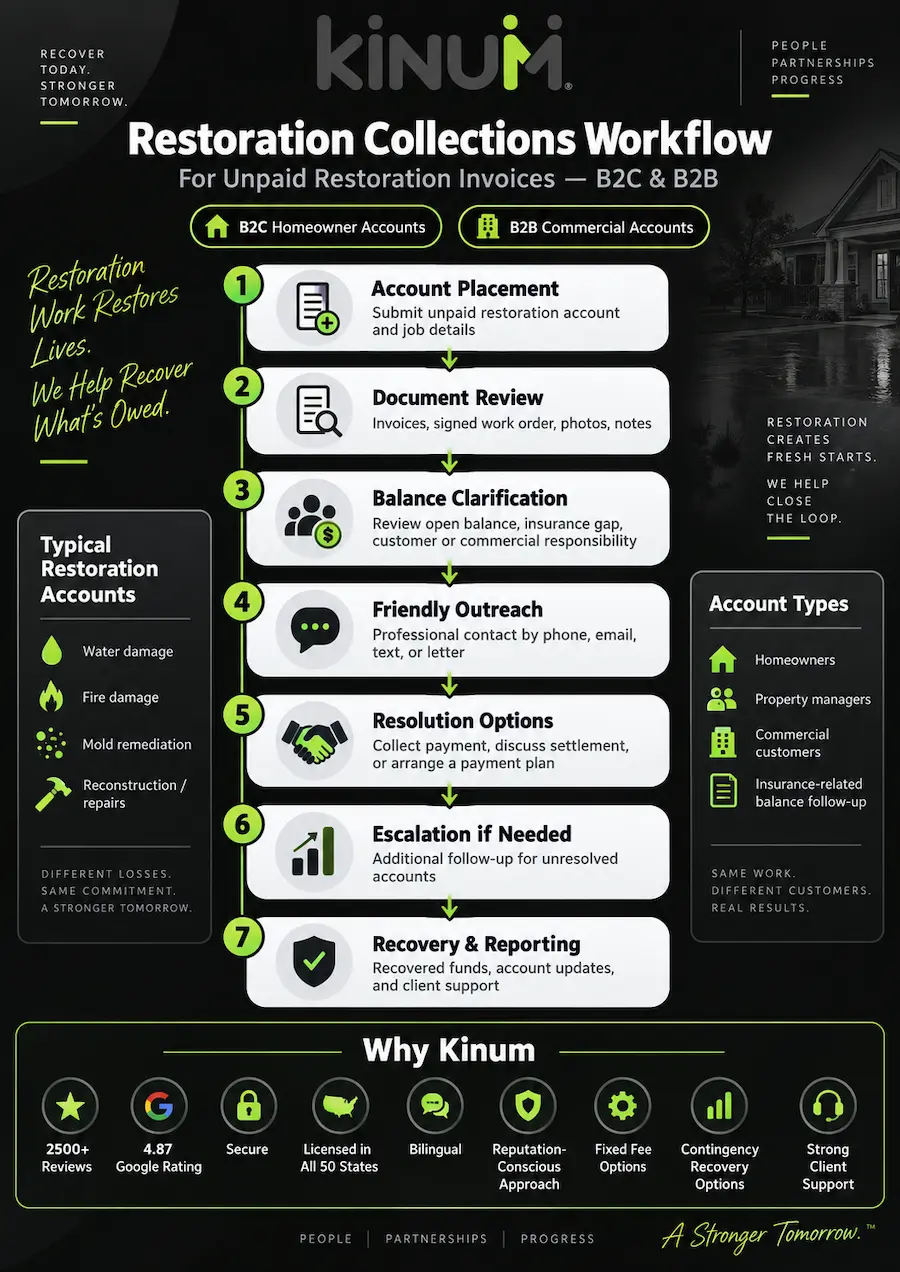
Kinum supports both residential and commercial restoration accounts with flexible collection options. Our services include fixed-fee and contingency recovery programs, bilingual support and experienced client service. Kinum is licensed to provide collection services across all 50 states and takes a professional, reputation-conscious approach to customer communication.
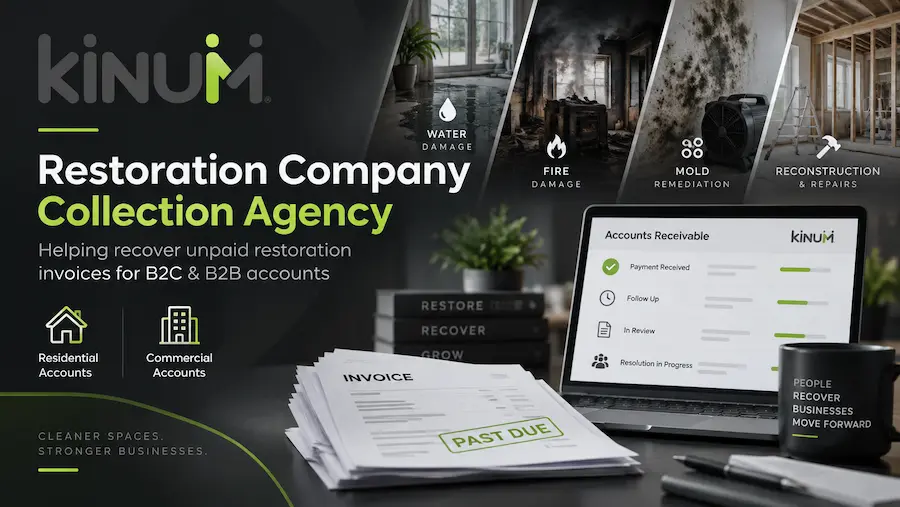
2,500+ reviews • 4.87 Google rating • Secure • All 50 states • Bilingual support • Fixed-fee & contingency options
Have unpaid restoration invoices that have stopped moving?
Talk to Kinum about collection options
Why Restoration Companies End Up With Unpaid Invoices
Restoration billing is different from many other service businesses.
When a home or commercial property experiences water damage, fire damage or another emergency, work may need to begin quickly. The restoration company cannot always wait for every insurance question to be resolved before starting mitigation.
That creates situations where the work is completed first and the final payment details are sorted out later.
Common reasons restoration invoices remain unpaid include:
- Insurance paying less than the amount originally billed
- Deductibles or other customer-responsible amounts remaining unpaid
- Delayed or partially processed insurance payments
- Insurance checks being sent to the property owner or requiring additional endorsement
- Supplements or portions of the scope remaining unresolved
- Additional work requested outside the amount covered by insurance
- Customers assuming insurance handled the entire invoice
- Commercial property owners, landlords or businesses delaying payment
- Final reconstruction invoices remaining unpaid after emergency mitigation is complete
An insurance payment does not, by itself, tell a restoration company what should happen with every remaining balance.
The better approach is to review the contract, account history, insurance payment information and customer communications before deciding what amount should continue through the collection process.
Contact us for Restoration Collections
|
|
Insurance Paid Part of the Invoice. What Happens to the Rest?
This is one of the most common questions restoration companies face.
The first step should be determining why a balance remains.
For example, the remaining amount could relate to a deductible, work outside the covered scope, a difference between the restoration invoice and insurer payment, additional customer-authorized services, or an insurance matter that is still being reviewed.
Those situations should not all be treated the same way.
Before sending an account to collections, make sure the amount being referred is clearly identified and supported by the available records.
That makes the account easier to understand for the customer and easier for a collection agency to work.
Documentation Can Make Restoration Collections Easier
Restoration companies often have excellent documentation because documenting damage and completed work is already part of the job.
That information can also be valuable when an account becomes delinquent.
Useful records may include:
- Signed work authorization or service agreement
- Final invoice and account statement
- Scope of work
- Before-and-after photographs
- Completion documents
- Customer-approved change orders or additional work
- Insurance payment information available to the restoration company
- Explanation of benefits, estimate or payment notice when available
- Record of payments already received
- Emails, texts or other customer communications concerning the balance
The goal is simple: someone reviewing the account should be able to understand what work was performed, what was billed, what was paid and what remains outstanding.
Don’t Let an Insurance Question Become a 180-Day-Old Receivable
One of the biggest problems with restoration accounts is that companies sometimes wait because everyone assumes insurance is still handling the matter.
- Thirty days becomes sixty.
- Sixty becomes ninety.
- Eventually, the restoration company discovers that nothing is actually moving.
A useful internal question is:
Is this account actively progressing, or are we simply waiting?
If the insurer, customer or commercial client is actively resolving the balance, continued internal follow-up may make sense.
But when the payment status is clear and normal reminders are no longer producing progress, moving the account into a structured collection process may be more effective than allowing it to continue aging.
Residential and Commercial Restoration Accounts Are Different
Restoration companies may work for homeowners one day and commercial property owners the next.
That means unpaid restoration receivables can include both B2C and B2B accounts.
Residential accounts may involve homeowners, insurance payments, deductibles and customer balances.
Commercial restoration accounts may involve:
- Property management companies
- Apartment communities
- Hotels
- Restaurants
- Office buildings
- Retail locations
- Contractors
- HOAs
- Commercial property owners
- Other businesses
Because these accounts can have very different documentation and payment structures, restoration companies benefit from separating consumer and commercial accounts before referring them for collection.
When Should a Restoration Company Consider a Collection Agency?
There is no single number of days that works for every restoration account.
Instead, look at the status of the account.
A collection agency may become appropriate when:
- The work is complete
- The final amount due has been established
- Insurance-related questions affecting the balance have been reasonably clarified
- The customer or business has received the invoice
- Routine reminders have stopped producing meaningful progress
- Payment promises repeatedly go unfulfilled
- The account is continuing to age without a clear reason
The objective is not to rush every slow-paying customer into collections.
It is to recognize when an account is no longer simply slow and has become genuinely stalled.
A Professional Approach Matters in the Restoration Industry
Restoration companies often meet customers during stressful situations.
A homeowner may have just experienced a flood, fire or major property loss. Commercial clients may be dealing with business interruption and unexpected expenses.
That does not mean legitimate invoices should be ignored.
It does mean communication matters.
A professional collection approach should clearly explain the outstanding balance, provide the customer with an opportunity to respond and separate genuine billing questions from accounts where payment has simply stopped.
This is particularly important for restoration companies because online reviews, referrals, insurance relationships and local reputation can matter long after a single job is finished.
How Kinum Can Help Restoration Companies With Past-Due Accounts
Once routine internal follow-up stops working, continuing to have project managers, office staff or restoration technicians chase old invoices can become expensive and distracting.
A collection agency gives the account a different level of attention while allowing the restoration company to focus on new jobs.
Kinum can help restoration companies pursue overdue residential and commercial accounts through structured collection services.
The restoration company provides the account information and supporting documentation, and the collection process can then focus on recovering the outstanding balance professionally.
Have restoration invoices that are no longer moving?
Contact Kinum to discuss your past-due accounts
Frequently Asked Questions
Can a restoration company send an unpaid invoice to collections?
Yes, an overdue restoration invoice may be appropriate for collection once the company has established the balance, completed its normal billing follow-up and confirmed that the account is genuinely past due. Good documentation makes the collection process much easier.
What if insurance paid only part of our restoration invoice?
First determine why the difference exists. The remaining amount could involve a deductible, uncovered work, additional services, an unresolved insurance issue or another billing difference. Review the signed agreement, payment history and available insurance information before referring the remaining balance for collection.
What documents should a restoration company provide to a collection agency?
Useful documents typically include the signed work authorization or agreement, final invoice, account statement, scope of work, supporting photos, change orders, payment records and relevant customer or insurance communications.
How long should a restoration company wait before sending an account to collections?
There is no universal waiting period for every restoration invoice. The more useful question is whether the account is still actively progressing. Once the balance is clear, routine follow-up has been completed and payment has stalled, it may be appropriate to consider professional collection support.
Can a collection agency handle both homeowner and commercial restoration accounts?
Restoration companies may have both residential and commercial receivables. Homeowner balances and business-to-business balances should be identified correctly because the account type, documentation and collection approach may differ.
Should we wait if the customer says the insurance company is still processing the claim?
Verify whether something is actually pending. If there is an active insurance review, additional documentation request or payment in process, the account may simply need more time. If nothing meaningful is happening and the remaining balance has already been established, continued waiting may simply cause the receivable to age.
Written by Sachin Goyal | Business Development Partner at Kinum