Most businesses don’t struggle because they lack sales. They struggle because cash flow—the oxygen of your business—gets trapped in Accounts Receivable. In the B2B world, silence from a debtor is rarely an accident; it is often a calculated delay that costs you interest and growth opportunities. At Kinum, we transform “difficult conversations” into a structured reconciliation process that prioritizes your bank balance without compromising your professional reputation.
Kin (Family/People) + Num (Numbers) = People before numbers. That’s not a slogan. It’s how we recover money without turning your customer into your enemy. Backed by over 2,700 Google reviews with a 4.87 rating, we are trusted by commercial businesses nationwide.
Secure Your Revenue – Contact Kinum Today
Our Two-Phase Recovery System
We offer a flexible, low-friction entry point for every type of debt:
-
The Connect Phase (Flat-Fee): Perfect for early-stage debt. For under $20 per account, we provide professional, branded outreach. You keep 100% of the recovered funds.
-
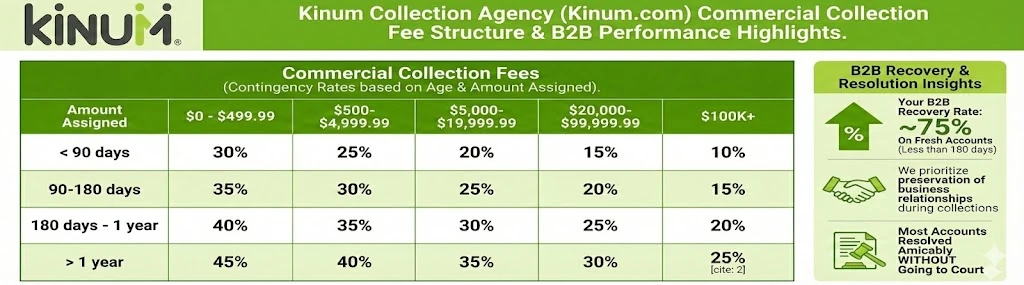
The Collect Phase (Contingency): For tougher, older balances. We utilize our full investigative suite and mediation expertise. Our incentives are aligned: No recovery = No fee.
Tailored Recovery for Your Industry
Generic collections fail in specialized B2B sectors. We provide niche expertise to address your specific pain points:
-
Construction & Trades: We navigate the nuances of retention and mechanic’s liens to protect your right to payment.
-
Wholesale & Distribution: We focus on high-volume liquid turnarounds to keep your supply chain moving.
-
Professional Services: We bridge the gap between “work completed” and “funds received” by resolving billing disputes with diplomatic precision.
The Step-by-Step Process
Step 1: The “Clean Handoff” & Readiness Checklist
Commercial collections is most successful when your file is airtight. Before you assign an account, ensure you have the “Big Four”: Identity, Agreement, Fulfillment, and Communication.
Commercial Collections Readiness Checklist:
-
Debtor ID: Legal entity name, physical address (not just a PO Box), and primary contact (CFO/Owner) details.
-
Proof of Agreement: Signed contracts, Purchase Orders (POs), or credit applications.
-
Proof of Fulfillment: Itemized invoices, signed Delivery Receipts (BOL), or project sign-off emails.
-
Communication Trail: Records of payment promises, acknowledged debt, or documented disputes.
Missing just one document is the #1 reason debtors successfully stall payments. Provide a clean handoff to move from “chasing” to “closing.”
Step 2: Consultation & Intel
We review documentation for signals that shape strategy, such as business continuity risk and payment behavior patterns. We run a Litigation Scrub to identify high-risk accounts immediately.
Step 3: Verification & Formal Notice
We send demand communications through multiple channels so the debtor cannot hide behind “we didn’t receive it.” The tone is professional but firm.
Step 4: Human-to-Human Mediation
We replace aggressive “robo-calls” with skilled B2B mediators. We contact decision-makers—owners, CFOs, and AP managers—to resolve disputes at the source and preserve the business relationship.
Step 5: Deep-Dive Investigation
If a debtor stalls, we utilize skip tracing, bankruptcy checks, and asset search indicators. This is how “silent accounts” suddenly become responsive.
Step 6: Modern Levers & Tech
Beyond reporting to business credit bureaus, we utilize AI-driven negotiation tools and secure digital payment portals to remove every friction point to settlement.
Step 7: Pre-Legal Review & Attorney Network
If a debtor refuses to cooperate, we can escalate through our nationwide attorney network. We always seek your explicit permission before moving to court.
Trusted Commercial Recovery Built for Results
-
Zero Upfront Risk: Contingency-based recovery means you only pay when we successfully collect your funds. Legal step happens only after your written permission and only as the last resort.
-
Rapid Onboarding: Signing up takes less than 3 minutes, secure account setup happens in about 1 business day, with initial commercial demand letters deployed within 24 hours after an account is submitted on our secure client portal.
-
Proven B2B Expertise: Trusted by hundreds of commercial businesses nationwide to recover overdue invoices while preserving critical supply chain relationships.
The 60-Day Warning
Statistics show that the probability of full recovery drops significantly after 60 days. Acting now is the difference between a minor delay and a total loss. Kinum achieves an ~75% recovery rate on commercial accounts under 180 days when assigned early.
Red Flags: 3 Costly Mistakes
-
Waiting too long: Older invoices get “normalized” inside the debtor’s AP department.
-
Incomplete documentation: Missing a single PO can turn a payable invoice into a permanent dispute.
-
The Hidden Cost: Letting your staff act as a collections department drains morale and wastes hours better spent closing new deals.
Commercial Collections FAQs
When should unpaid B2B invoices be sent to a collection agency?
Many businesses consider third-party collection around 60–90 days past due, but repeated broken payment promises can justify acting sooner. The longer an account ages, the harder it can become to recover.
A broken payment promise can be a stronger warning sign than the number of days past due.
Can commercial collections protect an important customer relationship?
Yes. A professional B2B collector can handle the difficult payment conversation while your sales or account team maintains the business relationship. Kinum focuses on firm, professional communication rather than unnecessary confrontation.
Your sales team can stay the sales team—Kinum handles the uncomfortable conversation.
What if a customer suddenly disputes an invoice after months of promising to pay?
A late dispute does not automatically make the debt uncollectible. Contracts, purchase orders, invoices, delivery records and prior emails can help determine whether the dispute is legitimate or simply delaying payment.
A dispute that appears only after months of payment promises deserves a closer look.
What documents should I provide for commercial debt collection?
Provide whatever establishes what was agreed, what was delivered and what remains unpaid—typically contracts, credit applications, purchase orders, invoices, delivery or completion records, payment history and relevant emails.
The stronger the paper trail, the fewer places there are for a debtor to hide behind uncertainty.
What is the difference between fixed-fee and contingency commercial collections?
With fixed-fee collections, you pay upfront and generally keep 100% of amounts recovered. With contingency collections, Kinum charges a percentage only when money is successfully recovered.
The right model depends on the age, volume and difficulty of the accounts—not simply the balance owed.
For a large B2B debt, should I use a collection agency or an attorney?
For many well-documented commercial debts, professional collection is a practical first step before litigation. If collection efforts fail and the balance justifies escalation, Kinum can recommend attorney review—with your approval before legal action.
Litigation should usually be an escalation path, not the starting line.
The Kinum Reconciliation Team Strategy
We don’t treat your customers like targets. We treat them like businesses that need structure.
We step in, document the balance, open professional communication, and drive resolution without drama—so you recover cash, protect your brand, and move forward stronger.
Contact Us for Commercial Collections
Commercial Collections Readiness ChecklistUse this list to ensure your documentation is “collection-ready” before submission. 1. Debtor Identification
2. Proof of Agreement
3. Proof of Fulfillment
4. Communication History
Why This Checklist MattersMissing just one document—like a signed PO or an email confirmation—is the #1 reason debtors successfully stall payments. When you provide a “Clean Handoff,” you move from “chasing” a debtor to “closing” an account. |
Written by Sachin Goyal | Business Development Partner at Kinum