A commercial collection agency is a licensed third-party firm that recovers unpaid invoices, contract balances, and overdue receivables owed by one business to another — a process commonly called B2B debt collection. Unlike consumer debt collection, commercial debt is not governed by the Fair Debt Collection Practices Act (FDCPA), which means business debtors can be pursued with more persistent, direct outreach than individual consumer accounts.
Kinum’s commercial collections division combines an experienced team of business debt collectors, thorough debtor business research including credit checks and personal guarantee review, and a national network of attorneys — delivering an industry-leading success rate on viable commercial claims on a contingency basis: no recovery, no fee.
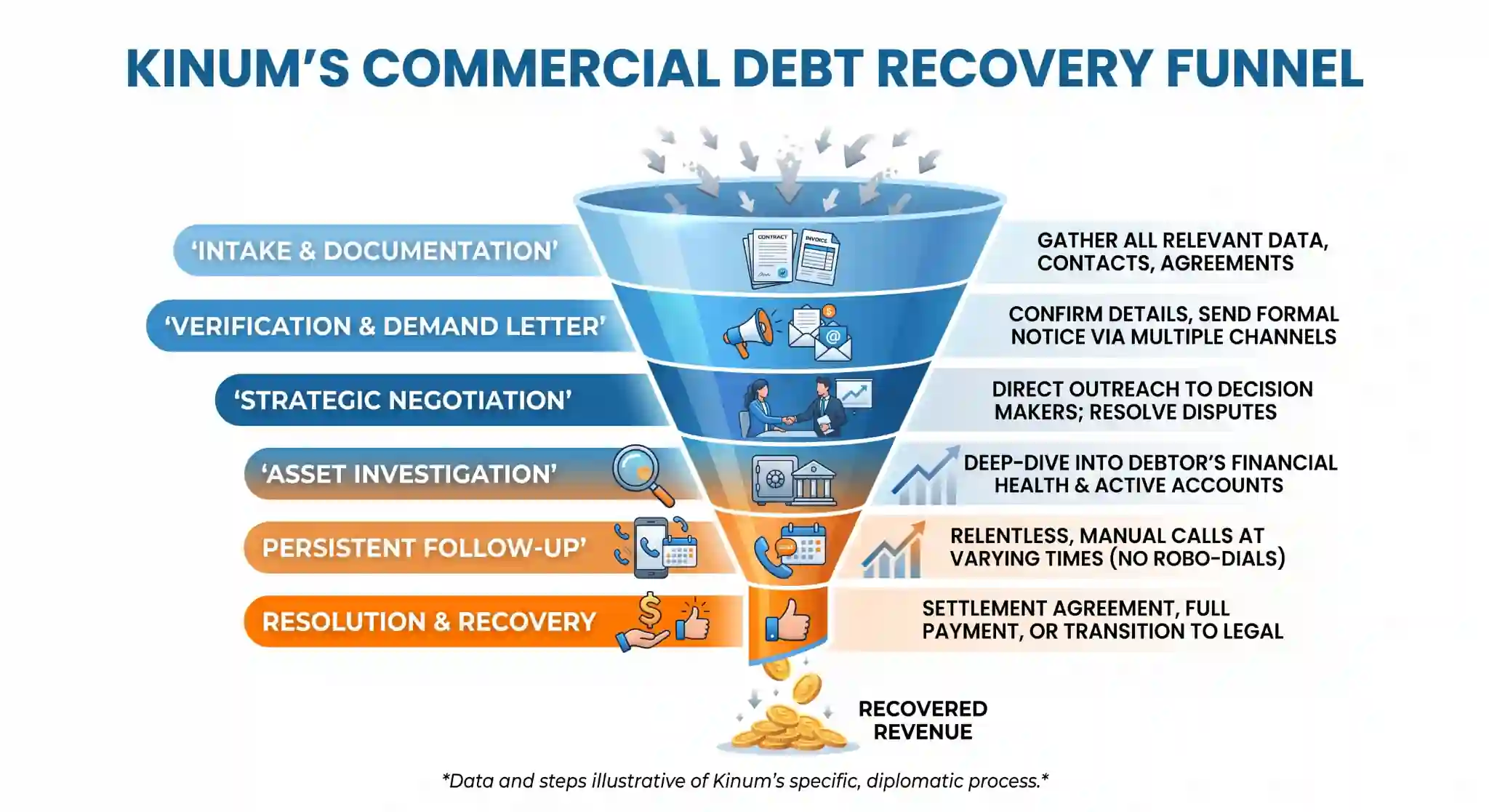
A commercial collection agency plays a vital role in helping businesses recover outstanding debts from other businesses. Kinum’s expertise lies in managing the delicate balance between aggressive debt recovery and maintaining professional relationships.
Commercial Debt Collection Process
- Kinum is among the best commercial collection agencies in USA. Rated 4.87 stars on Google.
- We have a dedicated commercial collections division with highly experienced business debt collectors.
- If we do not collect, we charge nothing. No Collection, No fee.
- Over success rate is impressive on viable claims. All debts are managed using our secure online client portal.
- There are several federal and state regulations to follow even when collecting your own money. We adhere to all government laws, thereby reducing your business risk.
Secure Your Revenue – Contact Kinum Today
Step by Step Approach:
| Step | Action | Key Objective |
| 1. Intake | Gather contracts, invoices, and debtor info. | Establish context and legal ground. |
| 2. Verification | Confirm contact info; send formal Demand Letter. | Formal notice of third-party involvement. |
| 3. Negotiation | Direct outreach to CFOs/Decision Makers. | Identify root cause and broker immediate payment. |
| 4. Investigation | Deep-dive into bank accounts and assets. | Determine financial health and leverage. |
| 5. Follow-Up | Persistent, manual (non-robotic) calls. | Maintain pressure until resolution. |
| 6. Resolution | Settlement or transition to Legal/Litigation. | Final recovery or judgment enforcement. |
The process typically involves the following steps:
- Initial Consultation and Information Gathering: Clients provide detailed information about the debtor and the outstanding debt. This includes contracts, sales agreements, and documented correspondence. This step is crucial for understanding the context and background of the debt.
- Verification and Demand Letter: We verify the contact information and send a demand letter via email, fax, and mail, generally within one business day. This letter serves as a formal notice to the debtor regarding the outstanding debt and informing that this debt is now being pursued by a professional collection agency. Things have got a lot more serious now.
- Strategic Negotiation (The “Human” Touch): We don’t rely on robo-dials. Our seasoned commercial collectors pick up the phone to negotiate with decision-makers (CFOs, AP Managers, Owners). We identify the root cause of non-payment—whether it’s cash flow issues or a dispute—and broker a resolution that gets you paid immediately.
- Asset & Liability Investigation :Before we push, we verify. We conduct a deep-dive investigation into the debtor’s financial health, looking for active bank accounts, vendor disputes, and personal guarantees. This intelligence tells us exactly how hard to push.
- Persistent Follow-Up: Kinum Inc. is relentless in its follow-up efforts, making multiple calls at different times of the day to reach the debtor. We avoid automated systems, relying on the expertise and intuition of experienced debt collectors to determine the best times and methods for making contact.
Success Rates and Expertise
Kinum Inc. boasts an impressive industry-leading success rate on viable claims, highlighting the effectiveness of their tailored and persistent approach. This high success rate is attributed to the extensive business experience of our debt collectors and legal team.
We adapt to your internal accounting systems and business priorities, acting as an extension of your own team. Our objective is to make this entire process easy for you and for your defaulter.
Legal and Non-Legal Steps
Non-Legal Steps
- Negotiation and Mediation: A significant part of the debt collection process involves negotiating with the debtor to reach a mutually agreeable settlement. This can often resolve the issue without the need for legal action.
- Credit Reporting: We may report the delinquent account to business credit bureaus, which can incentivize the debtor to settle the debt to avoid damaging their credit rating and ability of business to take loans in future.
Legal Steps
- Litigation: If non-legal measures fail, Kinum Inc. has an in-house pre-legal team before the actual legal process starts. We also have a national network of lawyers that enables us to file the case at the debtor’s local jurisdiction.
- Judgment Enforcement: Once a judgment is obtained, the agency can take further legal steps to enforce it, such as garnishing wages, placing liens on property, or seizing assets.
Contact us
|
|
Advantages of Using Kinum Commercial Collection Agency
- Expertise and Resources: Kinum team includes specialists with deep knowledge of business operations, contracts, and debt collection laws, providing a strategic advantage in recovering debts.
- Cost-Effectiveness: We operates on a contingency basis, meaning clients only pay a fee if the debt is successfully collected. This aligns the agency’s incentives with those of the client.
- Ethical and Professional Approach: Kinum prides itself on maintaining ethical standards, avoiding intimidation tactics, and focusing on professional negotiation to recover debts.
Types of Commercial Debt We Recover
| Industry | Common Debt Types | Kinum’s Approach |
|---|---|---|
| Construction & Contractors | Lien-related invoices, retainage disputes, subcontractor balances | Lien deadline review before collection; escalation via attorney network |
| Wholesale & Distribution | Trade credit invoices, Net 30/60/90 overdue balances | Volume account management; relationship-preserving outreach |
| Staffing & Workforce | Accumulated weekly/bi-weekly staffing invoices | Multi-invoice consolidation; direct AP department contact |
| Technology & SaaS | Subscription and licensing invoice disputes | Service acceptance documentation review; dispute neutralization |
| Professional Services | Legal, accounting, consulting fees | Professional-authority outreach appropriate to services sector |
| Manufacturing & Industrial | Large-balance delivery invoices, 90–180 day AR | UCC filing review; secured creditor priority assessment |
| Healthcare (Non-Consumer) | B2B vendor and supplier balances | Commercial track; separate from HIPAA consumer collection track |
| Commercial Real Estate | Lease disputes, vendor service invoices | Contract review; judgment lien on property as enforcement tool |
Benefits for our Business Clients
- Improved Cash Flow: Recovering outstanding debts can significantly improve your cash flow, allowing you to reinvest in your business and grow. Free up time of your employees, let them do what they were hired for.
- Reduced Financial Risk: By reducing the amount of outstanding debt on your books, you can lower your financial risk and improve your creditworthiness.
- Increased Profitability: Improved cash flow and reduced financial risk can lead to increased profitability for your business.
- Peace of Mind: Knowing that your outstanding debts are being handled by a professional collection agency can give you peace of mind and allow you to focus on running your business.
Contact us for B2B Collections
Our Commercial Collections Pricing:
| Commercial Contingency fee (Based on Account Age and Amount Assigned) | ||||
| Age: If > 1 year |
40% | 35% | 30% | 25% |
| 180 days – 1 year | 35% | 30% | 25% | 20% |
| 90-180 days | 30% | 25% | 20% | 15% |
| < 90 days | 25% | 20% | 15% | 10% |
| Amount Assigned -> | $500- $5k |
$5k- $20k |
$20k- $100k |
$100K + |
The chart above is for reference purposes only. Fees may vary based on factors such as case complexity and other case-specific circumstances. The exact fee will be confirmed when the case is assigned to us.
FAQ’s
Does the FDCPA apply to commercial (B2B) debt collection?
No. The Fair Debt Collection Practices Act (FDCPA) applies exclusively to consumer debts incurred for personal, family, or household purposes (15 U.S.C. § 1692a(5)). Business-to-business debts fall entirely outside the statute. This means commercial debt collectors are not legally required to observe the FDCPA’s calling hour restrictions (8 AM–9 PM), frequency caps (Regulation F’s 7-call/7-day limit), or 5-day debt validation notice requirements. Commercial collection is instead governed by the original service contract, state commercial law, and the UCC. Exception: California’s SB 1286 (effective July 1, 2025) extends consumer-style protections to commercial debts ≤ $500,000 where the debtor is a natural person.
How much does a commercial collection agency charge?
Most commercial collection agencies, including Kinum, operate on a contingency basis — charging a percentage of amounts actually recovered, with no fee if nothing is collected. Contingency rates for commercial accounts typically range from 25–50% depending on account age, balance, and complexity. There are no setup fees or upfront costs with Kinum. The only out-of-pocket expense is the court filing fee if the client authorizes legal escalation — which is reimbursed 100% from the first funds recovered. Contact Kinum for a quote specific to your account portfolio.
When should a business hire a commercial collection agency?
The optimal time to place a commercial account with a collection agency is 60–90 days after the invoice due date, following at least two internal reminder attempts. Recovery rates decline sharply after 120 days and fall significantly again after 180 days. Accounts over a year old are generally the most difficult to recover. If a debtor has stopped responding to your communications entirely, or has made and broken multiple payment promises, those are strong signals to escalate to a third-party agency. Waiting longer rarely produces payment — it reduces the likelihood of recovery.
What is a personal guarantee and how does it affect B2B debt collection?
A personal guarantee is a legally binding promise by a business owner, partner, or officer to repay a business debt personally if the business entity cannot or does not pay. When a personal guarantee exists, the debt collection agency can pursue the guarantor as an individual in addition to the business entity. This significantly expands enforcement options — even if the debtor business has no collectible assets, the guarantor’s personal assets (wages, bank accounts, real property) may be reachable through a judgment. Kinum reviews all documentation for personal guarantees as part of its debtor research process before developing a recovery strategy.
Can a commercial collection agency report B2B debt to credit bureaus?
Yes. Kinum can report delinquent commercial accounts to business credit bureaus, including Dun & Bradstreet and Experian Business. Business credit reporting is one of the most effective leverage tools in commercial collections — a reported delinquency can block the debtor business from opening new vendor credit lines, securing business loans, and passing supplier credit checks. Unlike consumer credit reporting (which has specific FCRA pre-reporting notice requirements), business credit reporting is not subject to the same federal restrictions.
What is the statute of limitations on commercial debt?
The statute of limitations on commercial debt — the period within which a lawsuit must be filed — varies by state and contract type. For written commercial contracts, the limitation period is typically 4–6 years depending on the state. Under UCC Article 2, claims for the sale of goods carry a 4-year default limitation period in most states. Open-account trade credit claims may carry a shorter period (2–3 years in some states). Once the statute of limitations expires, the debt is “time-barred” and a court can dismiss any lawsuit filed to collect it. Kinum’s pre-litigation team verifies the applicable statute of limitations before recommending legal escalation.
How long does commercial debt collection typically take?
Non-legal commercial collection — demand letters and telephone outreach — typically produces a resolution within 30–90 days for accounts where the debtor is reachable and the underlying debt is not disputed. Accounts with disputed balances or unresponsive debtors may take 90–180 days through the non-legal phase before a legal escalation recommendation is made. Legal escalation adds additional time: pre-litigation review (2–4 weeks), attorney demand and response window (35 days), lawsuit filing and service (2–4 weeks), and court proceedings (30 days to 9 months depending on jurisdiction and whether the debtor contests the claim). Kinum provides timeline estimates at each escalation decision point.
What is the UCC and how does it affect commercial debt collection?
The Uniform Commercial Code (UCC) is a set of standardized laws governing commercial transactions adopted in all 50 states. In commercial debt collection, the UCC is relevant in two ways. First, Article 2 governs the sale of goods and sets the default 4-year statute of limitations for sale-of-goods claims. Second, Article 9 governs secured transactions — if a creditor holds a UCC security interest in the debtor’s equipment, inventory, or receivables, that creditor has priority over unsecured creditors in recovering from those assets. Kinum reviews UCC filings on debtor businesses as part of its research process to assess asset availability and creditor priority before recommending a collection strategy.
How does Kinum handle commercial debtors who claim they dispute the invoice?
Invoice disputes are the most common defense raised by commercial debtors — and they are frequently used as a delay tactic rather than a genuine legal defense. Kinum’s process begins with a full review of the supporting documentation (contract, purchase order, delivery confirmation, any prior correspondence acknowledging the debt). Where documentation is complete, Kinum’s collectors respond to dispute claims with specific reference to the contractual terms and documented evidence, which neutralizes most tactical disputes quickly. Where the debtor raises a genuine contractual dispute, Kinum notifies the client and provides a factual summary of the debtor’s position before recommending a negotiated settlement or legal escalation path.
Does Kinum collect commercial debt across all 50 states?
Yes. Kinum holds active collection agency licenses in all 50 states, enabling pursuit of commercial debtors regardless of where their business is located or where they have relocated. This is especially important for creditors with customers in multiple states — a single Kinum relationship covers your entire national commercial portfolio without the need to manage separate regional agency relationships. Kinum’s national attorney network similarly covers all 50 states, ensuring that legal escalation can be filed in the debtor’s local jurisdiction in any state.
Written by Sachin Goyal | Business Development Partner at Kinum