Before you hand a stranger your accounts receivable and your company’s name, you should be suspicious of them. That’s not cynicism, it’s good vendor management. Most commercial collection agencies want you to trust them on faith: a slick homepage, a big promised recovery rate, a “call us” button. We’d rather you interrogate us. Below is exactly what a careful buyer should check before hiring any B2B collection agency, licensing, compliance, security, references, and exactly how Kinum answers each one. If we can’t survive that checklist, we don’t deserve the account.
Quick answer: Kinum recovers unpaid B2B invoices through a licensed, nationally bonded process, starting with verified contact and a formal demand letter, then direct negotiation with decision-makers, and legal escalation only when the numbers justify it. Fixed-fee and no-recovery-no-fee contingency options are both available.
Contact us for Commercial Collections
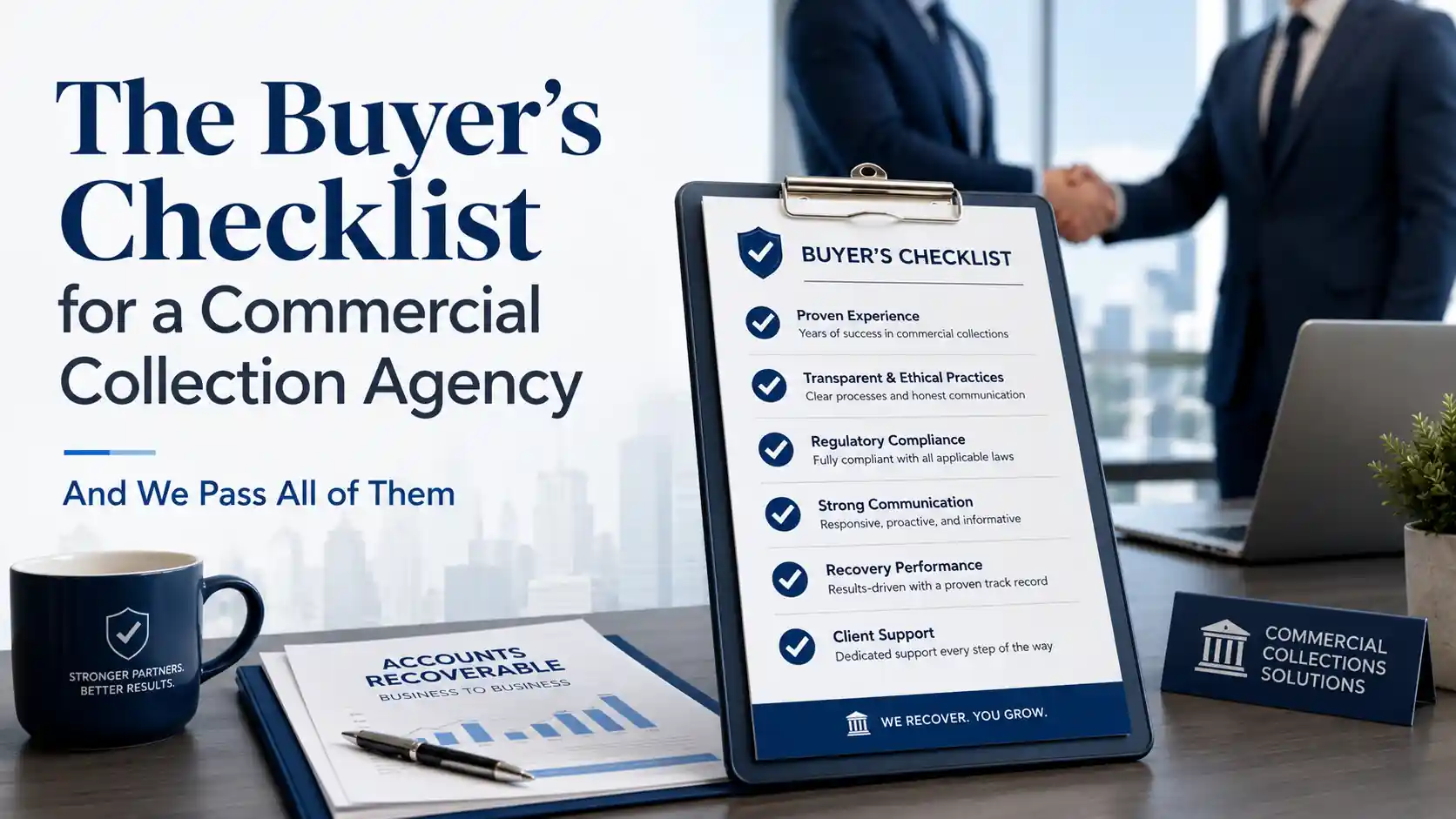
The Buyer’s Checklist for a Commercial Collection Agency
1. Are they actually licensed and bonded?
Anyone can put “licensed” on a website. Ask which states, and ask for proof. Kinum is bonded, insured, and licensed to recover in all 50 states and Puerto Rico, not just the state where the company happens to be headquartered.
2. What do real reviews say, not just the ones on their own homepage?
Testimonials curated by the agency itself are worth very little. Check an independent source. Kinum has 2,500+ Google reviews averaging 4.87 out of 5.0, one of the highest ratings among agencies in the industry.
3. Can they show their actual recovery numbers, not just a marketing claim?
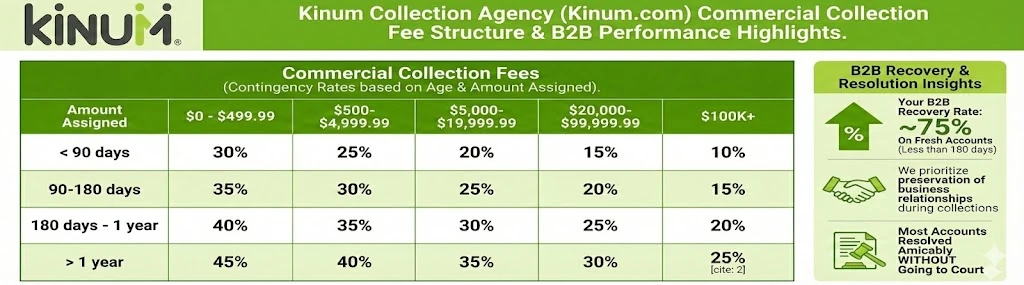
“High success rate” means nothing without a denominator. Accounts under 180 days old, with adequate documentation, recover at over 75%. Older or thinner-documented accounts are a different, lower number, and any agency that won’t give you that range isn’t being straight with you.
4. Is their data security independently audited, or just claimed?
This is where most buyers stop asking questions, and where they should ask more. Kinum has consistently passed SSAE 18 SOC 1 Type 2 review and is GLBA, PCI-DSS, and HIPAA compliant, with a dedicated IT security officer. Those aren’t interchangeable acronyms; see the FAQ below for what each one actually covers.
5. Will you get a real point of contact, or a rotating call queue?
You’ll be assigned a dedicated representative, reachable directly, with Kinum’s Central Client Support line (888) 471-0280 x4 as a backup if your rep is unavailable. Every account submits and tracks through a secure, 24/7 client portal.
6. Can you actually talk to a current client in your industry?
Most agencies won’t offer this because most can’t. Ask for an industry reference, someone who’s actually been through the process in a business like yours, and a legitimate agency should be able to connect you, with that client’s permission.
Once You’ve Placed the Account: What Actually Happens
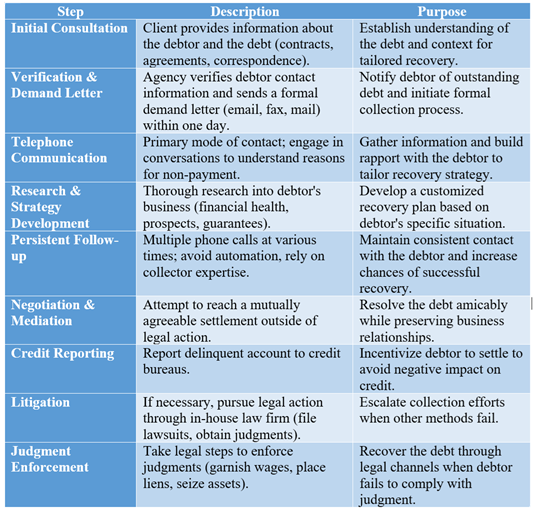
Verification and Demand Letter.
Contact information gets verified, and a formal demand letter goes out by email, fax, and mail, generally within one business day. This is the point where the debtor learns a professional agency, not just an increasingly annoyed vendor, is now involved.
Strategic Negotiation.
No robo-dialers. Experienced commercial collectors call the people who can actually authorize payment, CFOs, AP managers, owners, and negotiate directly rather than leaving voicemails into the void.
Legal Escalation, If It Comes to That.
When amicable recovery genuinely fails, an account can move to legal collections: pre-litigation review, documentation, and a lawsuit if the numbers support it. If a judgment is awarded, enforcement tools like wage garnishment, property liens, or asset seizure become available, though which one applies depends entirely on the debtor’s situation (see the FAQ below).
Every step runs on the same principle: ethical, professional negotiation, not intimidation. Aggressive tactics don’t just risk legal exposure, they tend to produce worse outcomes than a firm, credible conversation.
What This Costs
Two structures, chosen based on the account:
- Fixed Fee — predictable, low-cost, built for fresher accounts where a formal demand alone often gets results.
- No-Recovery, No-Fee Contingency — for accounts that need real work to collect. Nothing is owed unless money actually comes back.
Frequently Asked Questions
The compliance list mentions PCI-DSS. Why would a debt collection agency need payment-card security certification specifically?
Because debtors pay by card. Any time a collection agency accepts a credit or debit card payment directly, over the phone or through a portal, that transaction falls under PCI-DSS (the Payment Card Industry Data Security Standard), the same framework that governs how any merchant handles cardholder data. It’s narrower and more specific than HIPAA (health data) or GLBA (financial-institution data broadly); it exists because a debtor’s card number is its own category of sensitive information that needs its own safeguards.
The page mentions SSAE 18 SOC 1 Type 2. How is that different from the SOC 2 compliance other agencies advertise?
They audit different things. SOC 1 Type 2 focuses on controls relevant to financial reporting, proof that money moving through the agency is handled with proper accounting controls over time, not just at a single snapshot. SOC 2 Type 2, which other agencies often cite instead, focuses on security, availability, and confidentiality of data more broadly. Both are legitimate, independently audited certifications that simply verify different things.
The process mentions judgment enforcement, garnishment, liens, asset seizure. What does that actually look like in practice?
It varies significantly by state and by what the debtor actually owns. Wage garnishment redirects a portion of a debtor’s paycheck to satisfy the judgment, subject to state and federal limits. A lien attaches to real property, clouding the title so the debtor can’t sell or refinance without addressing the debt. Asset seizure, sometimes carried out through a writ of execution, allows a sheriff or similar officer to take specific non-exempt property. Which tool applies depends entirely on what the debtor has and where they’re located, which is why this stage runs through an actual attorney network rather than a one-size-fits-all script.
Why does this page suggest asking for industry references before signing up? Most agencies don’t offer that.
Because a track record that can’t be checked isn’t much of a track record. Recovery rates and star ratings are easy to publish and hard to verify from a homepage alone; a reference from a business in your specific industry, who’s actually gone through the collection process, tells you something a testimonial page can’t. It’s a genuine offer: current clients are asked for permission before being connected to a prospective one.

Contact us for Commercial Collections
|
|